
Boston Dynamics CEO Projects Domestic Robots Within 5-10 Years as Technology Accelerates
Boston Dynamics leadership envisions a near-term future where humanoid robots transition from industrial settings into homes and everyday environments, driven by rapid advances in robotics hardware and autonomous systems.
Boston Dynamics CEO Projects Domestic Robots Within 5-10 Years as Technology Accelerates
Boston Dynamics' leadership has outlined an ambitious timeline for the commercialization of domestic robots, projecting their emergence in household and consumer environments within the next 5 to 10 years. This forecast reflects significant progress in humanoid robotics, particularly in dexterity, mobility, and autonomous decision-making capabilities that have historically limited real-world deployment.
The projection underscores a pivotal moment in robotics development. While industrial robots have dominated manufacturing floors for decades, the transition to domestic applications requires solving fundamentally different engineering challenges—navigating unpredictable home environments, handling fragile objects, and operating safely alongside humans in close quarters.
Recent Hardware Breakthroughs
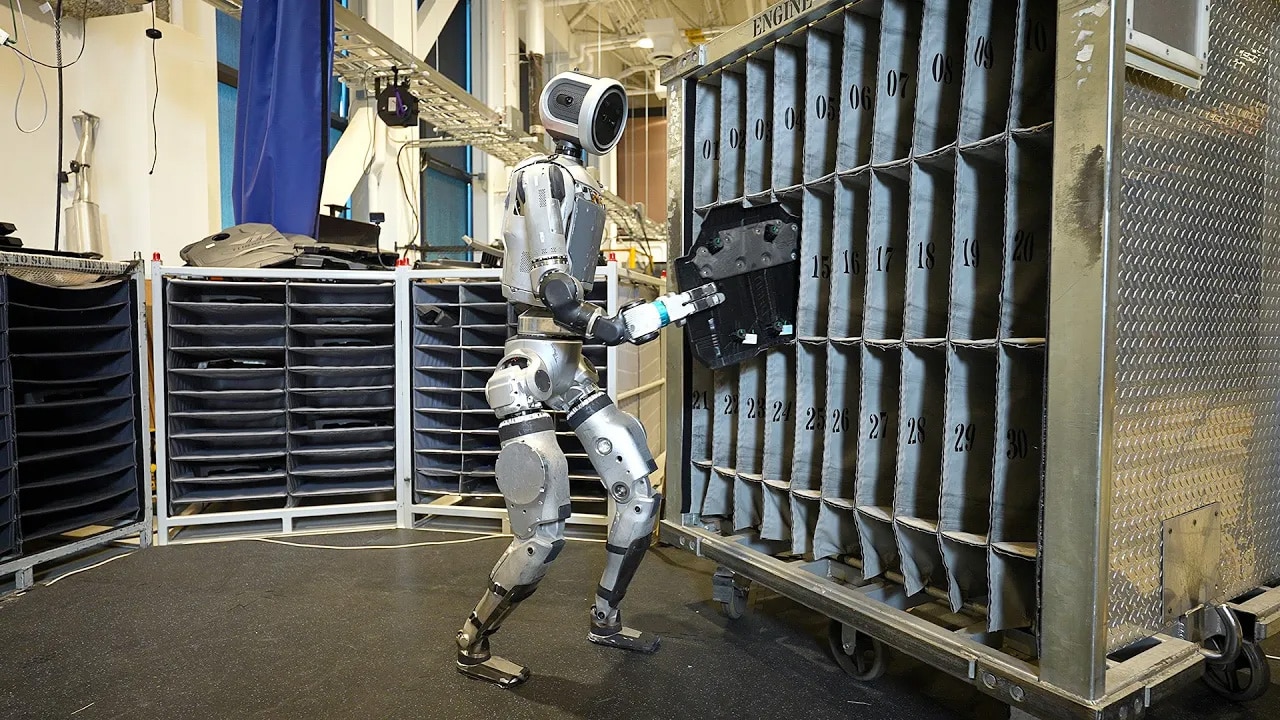
Boston Dynamics has demonstrated tangible progress toward this vision through recent hardware upgrades to its Atlas humanoid platform. The integration of advanced gripper systems, including the newly developed GR2 hands, represents a critical step forward in manipulation capabilities. These robotic hands feature unprecedented dexterity, enabling Atlas to perform complex tasks requiring fine motor control—from grasping delicate objects to executing multi-step manipulation sequences.
The company's focus on hand technology is particularly significant. Effective domestic robots must replicate human-like grasping and tactile feedback, capabilities that have proven technically challenging. Recent iterations demonstrate improved sensing, force control, and adaptive grip strategies that bring commercial viability closer to reality.
Technical Hurdles and Remaining Challenges
Despite optimistic timelines, substantial engineering obstacles remain:
- Autonomous navigation in cluttered, dynamic home environments
- Real-time decision-making for unpredictable scenarios
- Safety certification for human-robot interaction in residential spaces
- Cost reduction to achieve consumer-market pricing
- Battery endurance for extended operational periods
- Reliability and maintenance standards for consumer deployment
These challenges explain why even aggressive timelines suggest a 5-10 year window rather than immediate commercialization. The gap between laboratory demonstrations and mass-market products remains substantial.
Market and Industry Context
Boston Dynamics' projection aligns with broader industry momentum. Competitors including Tesla (Optimus), Figure AI, and others are pursuing similar timelines, suggesting genuine technological convergence rather than isolated optimism. Investment capital flowing into humanoid robotics has accelerated significantly, with venture funding reaching record levels in recent years.
The domestic robotics market represents a multi-trillion-dollar opportunity if successfully developed. Initial applications likely include household cleaning, maintenance tasks, elderly care assistance, and logistics within homes—domains where labor shortages and aging demographics create immediate demand.
What "Domestic Ready" Actually Means
The CEO's timeline likely refers to initial commercial availability rather than widespread adoption. Early domestic robots will probably target affluent early adopters, operate in controlled environments, and require significant human oversight. Full autonomy in genuinely unpredictable home settings remains years beyond even optimistic projections.
Regulatory frameworks for consumer robotics remain underdeveloped. Safety standards, liability protocols, and consumer protection mechanisms will require establishment before mass deployment becomes feasible. These regulatory timelines may ultimately constrain market entry more than technical capability.
Looking Forward
Boston Dynamics' 5-10 year projection represents informed optimism grounded in demonstrable progress. The company's track record of delivering on ambitious robotics goals lends credibility to the forecast. However, the transition from impressive demonstrations to reliable, affordable consumer products historically involves unexpected complications.
The emergence of domestic robots within this timeframe would represent a watershed moment in automation history—comparable to the personal computer revolution of the 1980s. Whether Boston Dynamics or competitors achieve this milestone first, the trajectory appears increasingly certain.
Key Sources
- Boston Dynamics official announcements regarding Atlas platform upgrades and gripper technology development
- Industry analysis of humanoid robotics market projections and competitive timelines
- Technical documentation on GR2 hand capabilities and autonomous system architecture


