
Bridging the AI Value Gap: Strategies for Success
Only 5% of companies capture real AI value, while 60% see minimal gains. BCG's report outlines strategies for bridging this gap and achieving success.
The Growing AI Value Divide
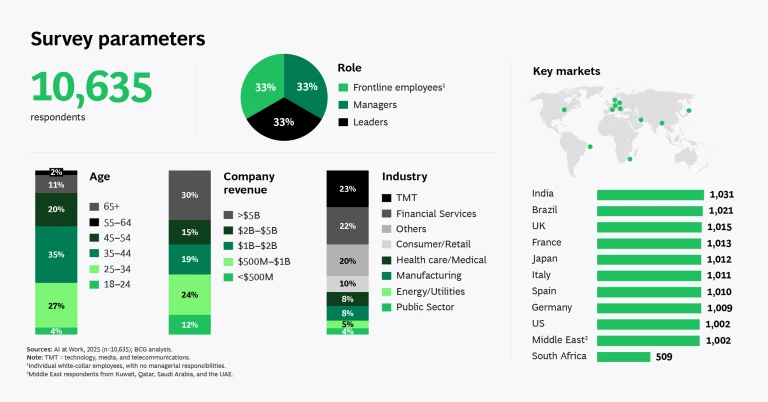
A recent survey by Boston Consulting Group (BCG) highlights a significant divide in AI adoption among companies. Only 5% of businesses are realizing substantial value from their AI investments, while a staggering 60% see minimal or no gains despite heavy spending. This divide is detailed in BCG’s 2025 report, The Widening AI Value Gap: Build for the Future, based on insights from over 1,250 senior executives across various industries.
Challenges in AI Adoption
The AI Value Gap
Most companies are trapped in what BCG terms the "AI value gap." Despite the global surge in AI adoption, many organizations struggle to convert investments into meaningful business outcomes. The primary barriers are organizational rather than technological:
- Lack of a clear strategy
- Insufficient leadership commitment
- Siloed operations
- Inadequate investment in talent and workflow redesign
Key Statistics
- 5% of companies achieve AI value at scale, evidenced by measurable revenue growth or cost reductions.
- 60% report minimal or no value from AI investments.
- Future-built companies experience 1.7 times the revenue growth, 1.6 times higher EBIT margins, and 3.6 times the three-year total shareholder return compared to laggards.
- AI agents account for 17% of total AI value in 2025, projected to reach 29% by 2028.
- Leaders plan to spend more than twice as much on AI as laggards in 2025.
Traits of Leading Companies
BCG identifies a "playbook" that sets top performers apart:
- CEO-led, multiyear strategic vision: Successful firms have a bold, top-down commitment to AI.
- Redesigned workflows: Leaders reinvent work processes, embedding AI into operations.
- Cross-functional ownership: IT and business units collaborate closely.
- Investment in talent: Continuous upskilling and hiring of AI-savvy employees.
- Technology and data foundation: Robust data infrastructure supports AI efforts.
The Rise of AI Agents
AI agents—systems capable of observing, planning, and executing tasks—are rapidly being adopted. These agents are particularly valuable in customer service, IT support, and HR operations. In regions like the Gulf Cooperation Council (GCC), adoption rates are higher, with 86% of companies integrating agents compared to 69% globally.
Industry Impact and Future Outlook
The AI value gap has profound implications. Companies that fail to act decisively may miss out on the next wave of productivity and innovation. Leaders are not just optimizing; they are redefining entire industries. For example, in healthcare, AI is driving breakthroughs in drug discovery and personalized medicine.
Recommendations for Businesses
- Embrace holistic transformation: Align strategy, operations, and culture around AI.
- Invest in organizational change and talent development.
For Policymakers and Educators
- Support workforce transitions to ensure AI benefits are widely shared.
For Investors
- Recognize the performance divergence between AI leaders and laggards.
Conclusion
The BCG 2025 report underscores a critical message: the AI revolution is accelerating, yet most companies are being left behind. Only 5% are capturing real value, and the gap between leaders and laggards is widening. Success requires bold leadership, strategic vision, organizational redesign, and sustained investment in people and technology. The rewards are substantial for those who act, while the risk of permanent disadvantage looms for others.


