
Meta's Stock Set for 70% Rally Amid AI Investment
Meta's stock is set for a 70% rally despite heavy AI investment, reflecting investor confidence in its long-term strategy and growth potential.
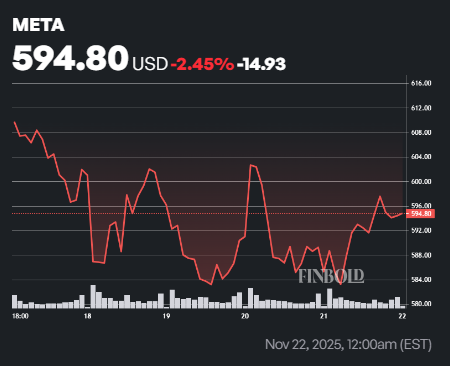
Meta’s Stock Poised for a 70% Rally Despite Heavy AI Investment Costs
Meta Platforms Inc., the parent company of Facebook, Instagram, and WhatsApp, is at a critical juncture where its stock shows strong potential to rally by as much as 70%, even as CEO Mark Zuckerberg doubles down on massive artificial intelligence (AI) spending plans. This paradox of high investment costs versus bullish stock outlook reflects deep investor confidence in Meta's long-term strategy centered around AI innovation and digital transformation.
Current Stock Performance and Forecast
As of early December 2025, Meta's stock (NASDAQ: META) trades around $648 per share, down from its all-time high near $796 recorded in August 2025. Market analysts and forecasting models indicate a broad price range with potential upside reaching above $1,000 within the next few years. One forecast projects the stock could climb to as high as $1,280 by January 2029, representing an approximate 70% rally from current levels.
Despite recent short-term volatility—with a December 2025 forecast predicting a slight decline of about 7.6% before recovering—long-term outlooks remain optimistic. Analysts suggest that Meta's stock is undervalued relative to its earnings power and future growth prospects, especially given its dominant position in social media and emerging AI technologies.
Massive AI Spending and Its Implications
Meta has committed to an unprecedented AI investment budget estimated at up to $72 billion for 2025 alone. This massive expenditure underscores the company's strategic pivot from primarily social media to becoming a leader in AI and metaverse technologies. While this spending has pressured Meta’s cash reserves—turning a net cash position of $20.7 billion in early 2025 into $6.6 billion net debt by Q3 2025—it is viewed as a necessary gamble to secure future growth drivers.
The AI initiative at Meta is significantly larger in scale than its Reality Labs metaverse division, and although costly, it is expected to generate considerable long-term value. Meta’s Q3 2025 revenue grew 26.2% year-over-year to $51.24 billion, beating analyst estimates and highlighting the company's resilience and ability to grow top-line revenue even amidst heavy R&D spending.
Financial Strength and Valuation Metrics
Meta boasts a strong balance sheet with a market capitalization around $1.9 trillion and a trailing twelve-month price-to-earnings (P/E) ratio of approximately 27, reflecting investor expectations of sustained profitability and growth.
Key financial metrics supporting Meta's bullish outlook include:
- Return on Assets (ROA): 25.37%
- Return on Equity (ROE): 38.86%
- Return on Invested Capital (ROIC): 30.23%
These returns underscore Meta's efficiency in generating profits from its assets and equity, ranking it favorably among Big Tech peers.
However, some caution arises from the stock trading at a premium relative to fair value estimates. Morningstar notes that META is trading at a 637% premium to its fair value of $462, indicating high investor expectations that hinge on successful execution of AI and metaverse initiatives.
Industry and Market Context
Meta operates in a highly competitive technology landscape where AI is rapidly reshaping business models and consumer interaction. Zuckerberg’s aggressive AI spending reflects a strategic imperative to maintain leadership against rivals like Google, Microsoft, and emerging AI startups.
The company’s AI efforts focus on advancing large language models, personalized content delivery, and augmented reality experiences—all critical for the future digital economy. Meta’s ability to integrate AI across its Family of Apps platform could drive significant monetization opportunities and user engagement, justifying investor optimism despite near-term financial pressures.
Risks and Considerations
While the growth potential is substantial, investors should weigh risks including:
- Large capital outflows reducing cash reserves and increasing debt levels in the short term
- Execution risks inherent in pioneering complex AI and metaverse technologies
- Regulatory scrutiny over privacy, AI ethics, and platform governance
- Market volatility and macroeconomic uncertainties impacting tech valuations
Visual Summary
- Meta Platforms Logo and Headquarters: Visual identification of the company.
- Stock Price Chart: Showing Meta’s price trajectory from 2024 through 2025 with key peaks and troughs.
- Mark Zuckerberg Speaking at an AI Event: Illustrating leadership commitment to AI.
- Graph of AI Spending vs. Revenue Growth: Visualizing the relationship between investment and financial results.
Meta Platforms stands at a transformative moment where heavy AI spending is fueling expectations of substantial future growth. Despite short-term financial strain, the company’s robust revenue growth, strong profitability metrics, and strategic vision underpin forecasts of a 70% stock rally in the coming years. Investors are watching closely as Meta aims to redefine its business model and sustain its position at the forefront of technological innovation.


