

Qwen's Image Editing Breakthrough: 2,511 Perspective Transformations Reshape AI Vision
Alibaba's Qwen Image Edit 2511 demonstrates a major leap in AI-driven perspective control, enabling precise angle adjustments across thousands of images. This technical advancement challenges existing image editing paradigms.
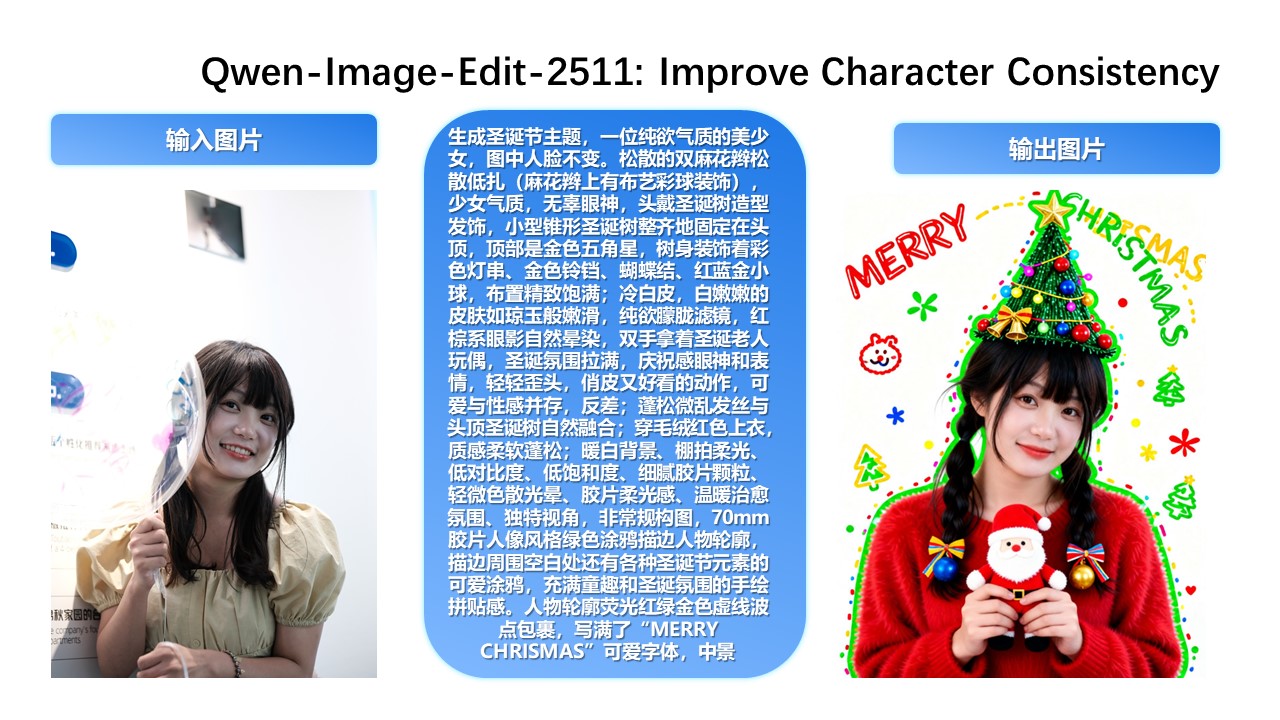
The Perspective Revolution in AI Image Editing
The competitive landscape for generative image tools just shifted. While competitors focus on photorealistic generation, Alibaba's Qwen team has achieved something more granular: precise control over image perspective. The Qwen Image Edit 2511 model successfully modified the viewpoint of 2,511 images, demonstrating a technical capability that goes beyond simple cropping or rotation—it's about reconstructing spatial relationships within visual content.
This matters because perspective control is one of the hardest problems in computational imaging. Most AI tools either generate entirely new images or apply surface-level edits. Qwen's approach appears to tackle the underlying 3D geometry of scenes, allowing photographers, designers, and content creators to reframe compositions without losing visual coherence.
How Perspective Editing Works at Scale
The technical architecture behind this capability reveals several important design choices:
- Spatial Understanding: The model must interpret 3D spatial relationships from 2D images, then reconstruct them from new viewpoints
- Content Preservation: Unlike generative approaches, perspective editing maintains original content while shifting the viewing angle
- Batch Processing: Successfully handling 2,511 images suggests robust inference pipelines and quality control mechanisms
According to technical demonstrations on YouTube, the editing process can be integrated into existing workflows. The model is also compatible with ComfyUI, a popular node-based interface for AI image generation, making it accessible to creators already invested in that ecosystem.
Real-World Applications and Limitations
The practical implications are significant:
Content Creation: Photographers can adjust camera angles post-capture, useful for product photography, real estate, and architectural visualization.
Data Augmentation: The 2,511-image dataset itself becomes a training resource, potentially improving model robustness across different perspectives.
Accessibility: Tools like this democratize capabilities previously requiring manual 3D modeling or expensive software.
However, questions remain unanswered. How does the model handle extreme angle changes? What happens with occluded objects—elements hidden from the original viewpoint? The technical documentation doesn't fully address failure modes or accuracy metrics compared to human-edited baselines.
Integration and Ecosystem Positioning
The model's availability through platforms like AIomnigen suggests Qwen is pursuing a distributed deployment strategy rather than a walled-garden approach. This contrasts with some competitors who restrict access to proprietary platforms.
The ComfyUI integration is particularly strategic. That ecosystem has become the de facto standard for AI image professionals, and early adoption there could establish Qwen as the go-to perspective editing solution.
What This Means for the Broader Market
Perspective editing represents a shift in how AI approaches image manipulation. Rather than replacing human creativity, it augments specific technical capabilities—much like how Photoshop's content-aware fill didn't eliminate photo editing, it just made certain tasks faster.
The 2,511-image benchmark is modest compared to training datasets, but it's a meaningful proof-of-concept. If Qwen can scale this reliably, it opens doors for other geometric transformations: depth adjustment, focal length simulation, and more sophisticated scene reconstruction.
For creators and enterprises, the question isn't whether perspective editing will become standard—it's which vendor will own that capability. Qwen's technical approach and open integration strategy position it as a serious contender, but the real test comes when users push these tools to their limits.


