
AI Agents Move Into Production: Enterprise Focus Shifts to ROI in 2026
As 2026 approaches, AI agents are transitioning from experimental pilots to production deployments. Organizations are prioritizing measurable return on investment, driving a fundamental shift in how enterprises approach autonomous AI systems.
AI Agents Move Into Production: Enterprise Focus Shifts to ROI in 2026
As 2026 approaches, the AI agent landscape is undergoing a critical transformation. What began as experimental pilots and proof-of-concept projects is rapidly evolving into production-grade deployments across enterprises. The driving force behind this shift is clear: companies need demonstrable return on investment, and they need it now.
The Production Imperative
The transition from lab to production represents a maturation of the AI agent market. Organizations that invested in early exploration are now facing pressure to deliver tangible business outcomes. This isn't theoretical anymore—it's about operational efficiency, cost reduction, and revenue generation at scale.
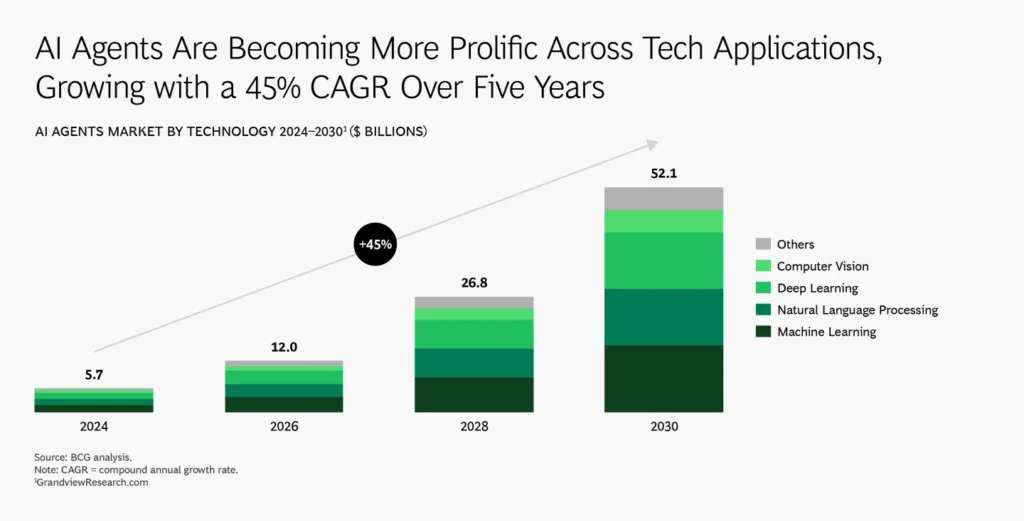
The market reflects this urgency. Industry projections indicate the AI agents market will reach significant valuations by 2034, with compound annual growth rates exceeding 45% over the next five years. But these numbers mask a more immediate reality: 2026 is shaping up as the year enterprises move past experimentation and into deployment.
Key Challenges in Production Deployment
Moving AI agents to production introduces complexities that lab environments don't capture:
- Reliability and Consistency: Production systems must operate 24/7 with predictable performance
- Integration Complexity: Connecting agents to existing enterprise systems and workflows
- Governance and Compliance: Ensuring agents operate within regulatory and organizational constraints
- Cost Management: Controlling inference costs and resource consumption at scale
- Monitoring and Observability: Tracking agent behavior and performance in real-world conditions
Organizations are learning that successful production deployment requires more than sophisticated algorithms. It demands robust infrastructure, clear governance frameworks, and measurable KPIs tied directly to business outcomes.
ROI as the Primary Metric
The shift toward ROI-focused deployment reflects a maturing market. Early adopters are moving beyond "Can we build this?" to "What value does this create?" This pragmatic approach is reshaping vendor strategies, implementation methodologies, and investment decisions.
Companies are targeting specific use cases where ROI is clearest: customer service automation, knowledge worker productivity enhancement, operational process optimization, and data analysis acceleration. These domains offer measurable impact—reduced support costs, faster turnaround times, improved accuracy, and better decision-making.
The competitive pressure is intensifying. Organizations that successfully deploy production AI agents will gain operational advantages over those still in pilot phases. This creates a cascading effect: early success stories drive broader adoption, which accelerates the timeline for competitive deployment.
Market Dynamics in 2026
The AI agents market is consolidating around practical applications. Vendors are shifting from broad capability claims to focused, vertical-specific solutions. Enterprise buyers are becoming more sophisticated, demanding clear ROI projections, implementation timelines, and support structures.
Industry analysis suggests the AI agents sector is positioned to exceed SaaS in market significance by 2026. This projection reflects not just market size but fundamental shifts in how enterprises consume AI technology—moving from software-as-a-service models to autonomous agent-based operations.
What's Next
As companies prepare for 2026, the conversation is shifting from possibility to execution. The organizations that will lead in this space are those that:
- Define clear success metrics before deployment
- Build robust monitoring and governance frameworks
- Integrate agents into existing workflows thoughtfully
- Invest in team training and change management
- Maintain realistic timelines and expectations
The AI agent transition to production is no longer a future scenario—it's happening now. The winners will be those who execute effectively while maintaining focus on measurable business impact.
Key Sources
- BCG AI Agent Statistics and Growth Analysis (45% CAGR projection, 2024-2029)
- CXO TV Industry Analysis (AI Agents market positioning relative to SaaS, 2026)
- Precedence Research Market Projections (USD 236.03 Billion valuation by 2034)


