
CTOs Predict Significant Job Displacement as AI Automation Accelerates Through 2030
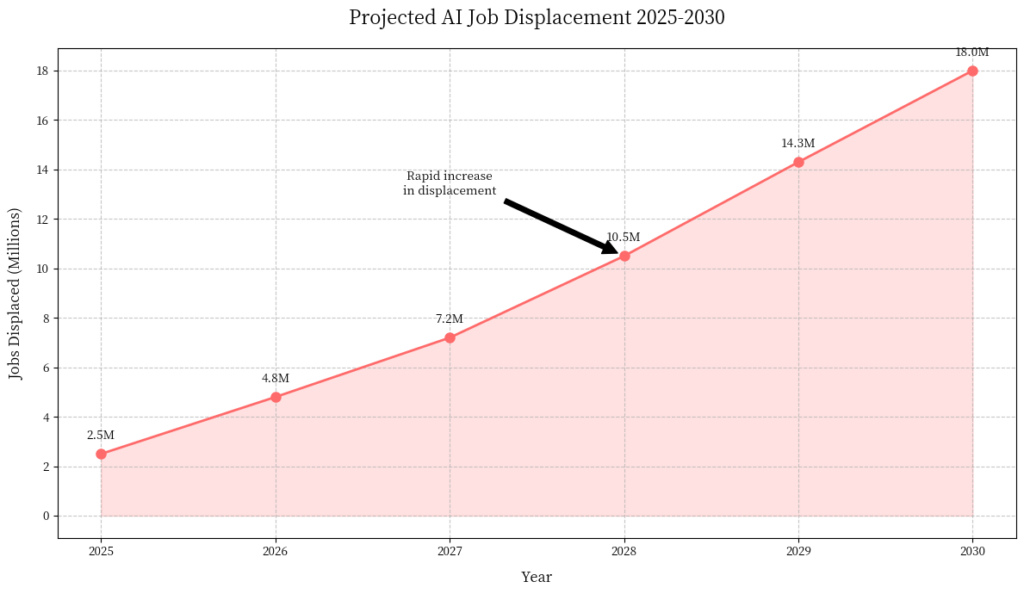
Chief Technology Officers across industries are sounding the alarm on artificial intelligence's impact on employment. New forecasts suggest millions of jobs could be displaced by 2030 as companies accelerate automation initiatives, prompting urgent questions about workforce adaptation and economic transition.
CTOs Predict Significant Job Displacement as AI Automation Accelerates Through 2030
Chief Technology Officers across industries are sounding the alarm on artificial intelligence's impact on employment. New forecasts suggest millions of jobs could be displaced by 2030 as companies accelerate automation initiatives, prompting urgent questions about workforce adaptation and economic transition.
The CTO Consensus on AI-Driven Job Loss
Technology leaders are increasingly confident that artificial intelligence will fundamentally reshape the labor market within the next five to seven years. Rather than viewing this as speculative, CTOs are treating workforce displacement as an inevitable consequence of automation adoption—not a possibility, but a probability embedded in their strategic planning.
The consensus reflects a broader industry trend: companies are moving beyond pilot projects and proof-of-concepts to enterprise-wide AI deployment. As these systems mature and prove their economic value, the pressure to implement automation across operational functions intensifies. CTOs recognize that competitive advantage increasingly depends on efficiency gains that AI can deliver.
Scope of Predicted Displacement
Current forecasts suggest substantial job losses across multiple sectors. Estimates indicate that millions of positions in the United States alone could be affected by 2030, with particular vulnerability in:
- Administrative and clerical roles
- Customer service and support functions
- Data entry and processing positions
- Routine analytical tasks
- Manufacturing and logistics operations
The displacement won't be uniform. Knowledge workers in certain domains face significant risk, while others may see job transformation rather than elimination. The critical variable remains the pace at which organizations adopt and scale AI solutions.
Automation Technologies Driving Change
Several AI technologies are accelerating this transition:
Generative AI has emerged as the most disruptive force, capable of handling content creation, code generation, and complex problem-solving tasks previously requiring human expertise. Machine learning systems continue to improve at pattern recognition and predictive analytics. Robotic process automation streamlines repetitive workflows across finance, HR, and operations.
CTOs emphasize that these aren't isolated tools—they're converging into integrated systems that can handle increasingly complex workflows with minimal human intervention.
Strategic Implications for Organizations
Rather than resisting automation, CTOs are positioning their organizations to capitalize on it. This involves:
- Identifying high-impact automation opportunities
- Retraining existing workforces for higher-value roles
- Restructuring teams around AI-augmented workflows
- Building new capabilities in AI management and oversight
The strategic question isn't whether to automate, but how quickly and comprehensively to do so. Companies that move slowly risk competitive disadvantage; those that move aggressively face workforce transition challenges.
The Broader Economic Question
CTOs' forecasts raise critical policy questions about workforce transition, reskilling programs, and social safety nets. The displacement projected for 2030 isn't distant—it's within current hiring cycles and career planning horizons. Workers entering the labor market today may face a fundamentally different employment landscape within a decade.
The technology community's role in this transition remains contested. While CTOs focus on implementation and efficiency, broader stakeholders are raising questions about responsible deployment and societal impact.
Key Sources
- Statista research on AI and future of work trends
- JobRight analysis: "How Many Jobs Will AI Replace by 2025-2030"
- TechSpot reporting on generative AI job displacement projections
The consensus among technology leaders is clear: AI-driven automation will reshape employment by 2030. The question now shifts from whether this will happen to how organizations, workers, and policymakers will adapt.


