
Google Cloud Releases 2026 AI Agent Trends Report
Google Cloud's 2026 AI Agent Trends Report outlines five transformative ways AI agents will reshape enterprise workflows, boosting productivity and automation.
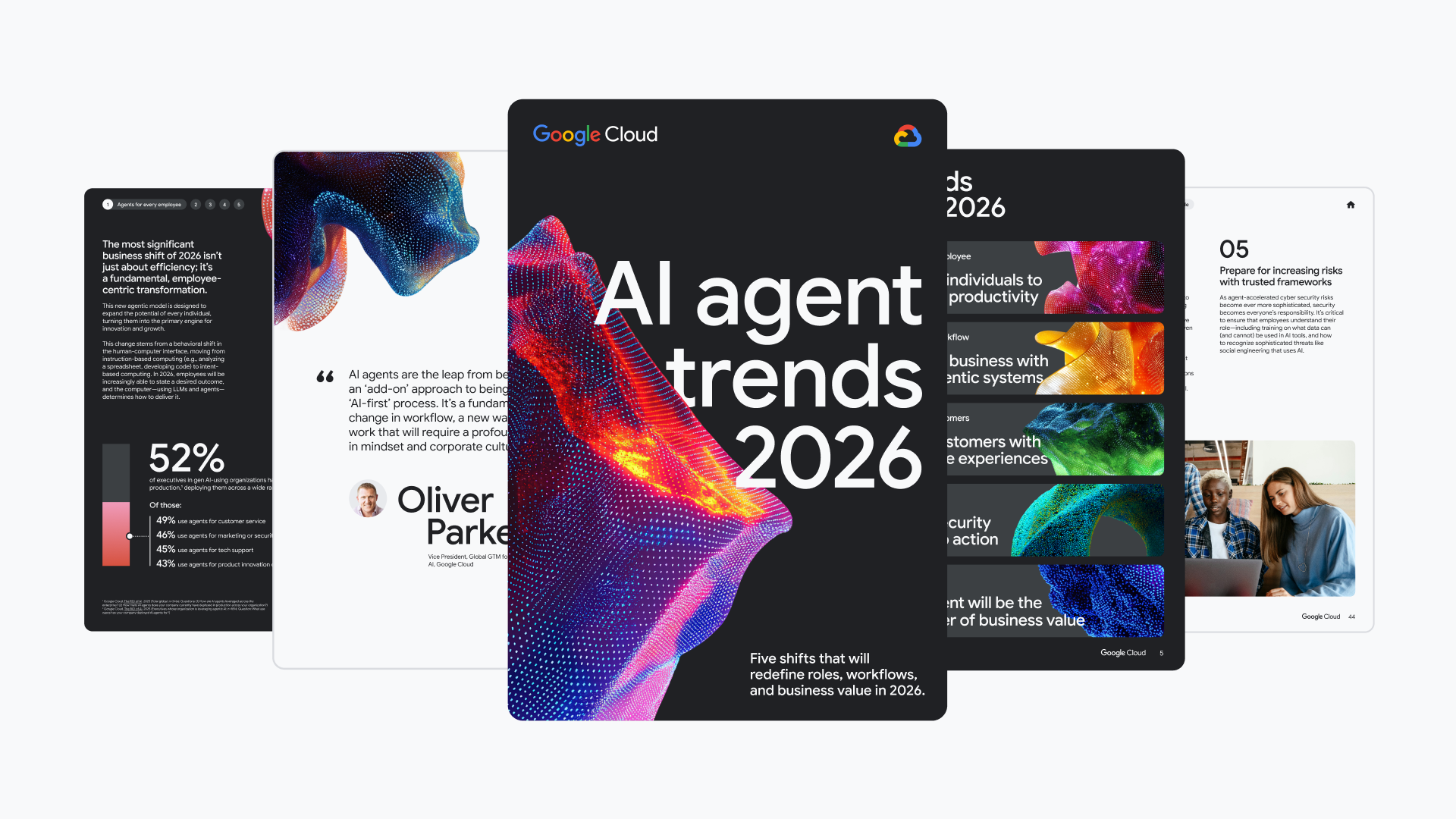
Google Cloud Unveils 2026 AI Agent Trends Report: 5 Ways Agents Will Reshape Workplaces
Google Cloud has released its highly anticipated 2026 AI Agent Trends Report, outlining five transformative ways AI agents will redefine enterprise workflows, boost productivity, and automate complex operations starting next year. Drawing from surveys of over 3,466 global executives and insights from Google AI experts, the report shifts focus from speculative AI hype to practical, semi-autonomous systems that plan, execute, and adapt under human oversight.
This launch arrives amid explosive growth in agentic AI, with projections showing 80% of enterprise apps embedding agents by 2026 and a 46%+ compound annual growth rate (CAGR) in adoption, fueled by gains in efficiency, cost savings, and decision speed. Businesses like Macquarie Bank already leverage Google Cloud AI agents for fraud detection, slashing false positives by 40% and boosting self-service usage by 38%.

Official cover of the Google Cloud 2026 AI Agent Trends Report, featuring abstract visualizations of interconnected AI agents and workflow diagrams.
The Five Key Trends from Google Cloud's Report
Google Cloud's report pinpoints specific evolutions in AI agents—intelligent systems that go beyond chatbots to handle multi-step goals autonomously. Here's a breakdown of the five ways AI agents will transform work in 2026:
-
Agentic Workflows Become Core to Business Processes: Businesses will connect multiple agents into collaborative networks for end-to-end automation, far surpassing simple queries. For instance, Salesforce and Google Cloud's Agent2Agent (A2A) protocol enables cross-platform interoperability, allowing agents to orchestrate sales, support, and supply chain tasks seamlessly.
-
Agents Supercharge Security Operations: In overwhelmed security operation centers (SOCs), AI agents will automate alert triage and investigations, freeing analysts for threat hunting. This trend addresses the data deluge, with predictions that agents will handle the most repetitive security tasks by 2026.
-
From Tasks to Full Systems: Agents evolve into "digital assembly lines," managing entire workflows rather than isolated prompts. Real-world applications include enhancing customer service, improving code quality, and accelerating threat detection, all while emphasizing human training for effective oversight.
-
Embedded Decision-Making: Nearly 85% of executives anticipate employees relying on agent recommendations for real-time decisions by 2026, integrating deeply with CRM, ERP, and industry clouds—expected to hit 70% enterprise adoption.
-
Scalable, Governed Deployment: Low-code platforms and robust governance will accelerate rollout, with multi-agent teams coordinating across functions like finance and operations.
These trends align with broader industry forecasts, such as Gartner's prediction that 15% of work decisions will be autonomous by 2028, up from near zero today.

Diagram from Google Cloud depicting interconnected AI agents collaborating on complex workflows, highlighting A2A protocol integration.
Broader Industry Momentum and Competitor Insights
The Google report echoes accelerating agentic AI adoption across tech giants. Salesforce's Agentforce platform deploys specialized agents for sales, service, and supply chains, enabling predictive, self-improving workflows with access to unified customer data. MuleSoft's 2026 trends emphasize API-led connectivity as the "glue" for agent actionability, shifting from static RPA to dynamic multi-agent ecosystems that invoke workflows and prototype applications rapidly.
Salesmate highlights autonomous digital coworkers and multi-agent teams, with a 282% surge in AI adoption per Salesforce research. By 2026, multi-agent systems will standardize, featuring domain-specific agents (e.g., forecasting, CX, security) that share data and divide tasks. Blue Prism forecasts seven trends, including safer governance and cybersecurity agents, underscoring agentic AI's rapid reshaping of enterprises.
In customer experience, autonomous agents promise 24/7 personalization, resolving issues and transactions with minimal human input—a game-changer for retail, finance, and healthcare. Crystallds notes agentic commerce and real-time intelligence on Google Cloud, powering warehouse-native customer data platforms.

Screenshot of Salesforce Agentforce interface showing multi-agent collaboration across sales, service, and operations.
Implications for Businesses and Workforce
Enterprises face a pivotal shift: AI agents as digital colleagues that reason, coordinate, and decide, demanding new data strategies, governance, and upskilling. Productivity gains are tangible—Google's examples show agents directing more users to self-service while cutting errors—but success hinges on human-AI symbiosis, with teams trained to guide agents effectively.
Challenges include ensuring interoperability via standards like A2A and APIs, plus trustworthy data to avoid biases or errors. ROI will stem from executable actions, not just advice, with 85% of leaders betting on real-time decisions. By 2026, industries adopting early—via platforms from Google, Salesforce, Microsoft—will gain competitive edges in speed and scale.
This report, accompanied by a NotebookLM companion, equips leaders with actionable blueprints. As agentic AI matures, 2026 marks the transition from assistant to autonomous partner, potentially automating 15% of decisions and embedding in 80% of apps.
Visualizing the Agentic Future

Infographic from Google Blog illustrating AI agents automating SOC tasks like threat triage at Macquarie Bank.
The momentum is undeniable: from Google Cloud's executive-backed insights to ecosystem-wide innovations, AI agents herald a workflow revolution. Organizations ignoring this risk obsolescence, while pioneers unlock unprecedented efficiency.


