

Nvidia and Fanuc Deepen AI Partnership to Accelerate Intelligent Factory Automation
Nvidia and Fanuc are collaborating to advance physical AI in industrial robotics, leveraging simulation and machine learning to enhance manufacturing automation and operational efficiency at scale.
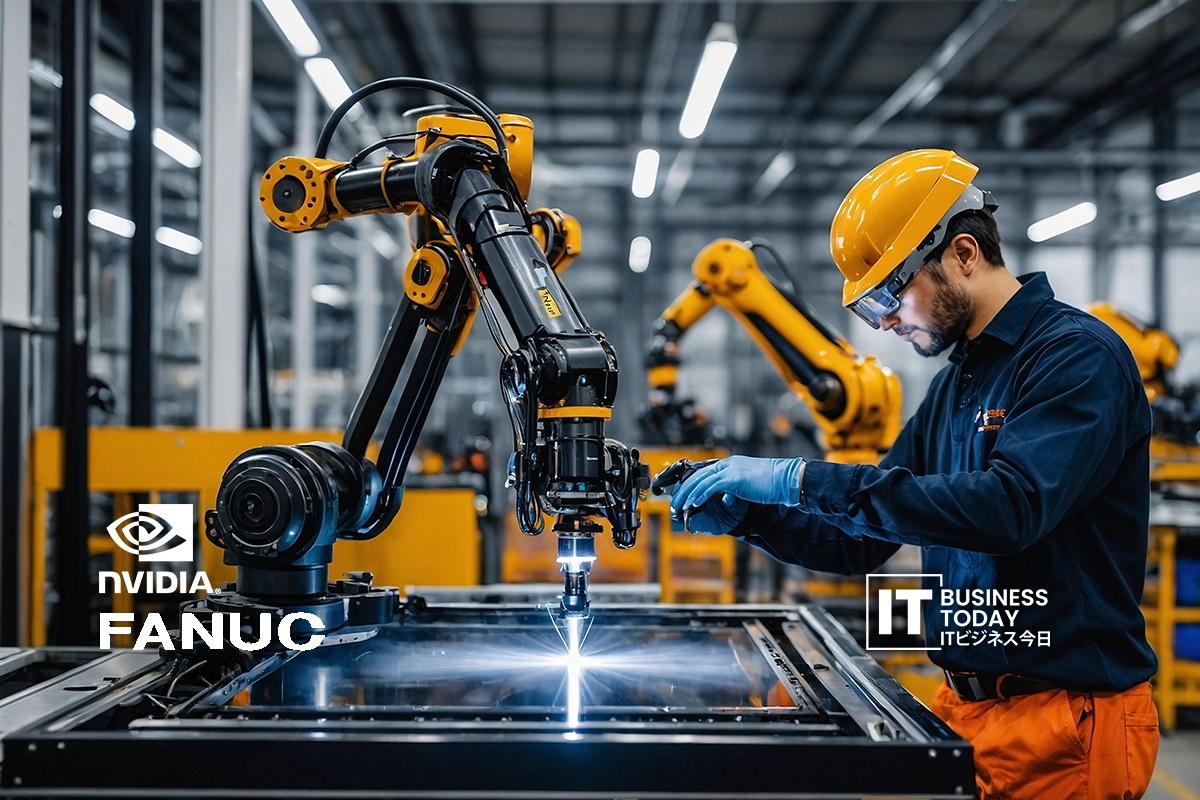
Nvidia and Fanuc Deepen AI Partnership to Accelerate Intelligent Factory Automation
Nvidia and Fanuc, two leaders in robotics and industrial automation, have announced a strategic partnership focused on advancing physical AI capabilities for next-generation factory robots. The collaboration aims to integrate Nvidia's AI and simulation technologies with Fanuc's robotics expertise to create more intelligent, adaptive systems capable of handling complex manufacturing tasks with minimal human intervention.
The Strategic Alliance
This partnership represents a significant step forward in the convergence of artificial intelligence and industrial robotics. By combining Nvidia's computational platforms and software frameworks with Fanuc's decades of robotics engineering experience, the two companies are positioning themselves to reshape how factories operate in the era of intelligent automation.
The collaboration focuses on leveraging Nvidia's Omniverse platform and Isaac robotics suite—tools designed specifically for simulating, training, and deploying AI-powered robotic systems. These technologies enable manufacturers to test robotic behaviors in virtual environments before deploying them on factory floors, reducing development time and operational risk.
Key Technical Innovations
The partnership emphasizes several core technical areas:
- Simulation and Digital Twins: Using Nvidia Omniverse Isaac Sim to create high-fidelity digital replicas of factory environments, allowing robots to learn and optimize behaviors before real-world deployment
- Machine Learning Integration: Applying deep learning models to enable robots to adapt to dynamic manufacturing conditions and improve task performance over time
- Edge Computing: Deploying AI inference directly on robotic systems to reduce latency and enhance real-time decision-making capabilities
- Scalability: Developing frameworks that allow manufacturers to scale intelligent automation across multiple production lines and facilities
Manufacturing Impact
The advancement of physical AI in robotics addresses critical challenges facing modern manufacturers. Traditional industrial robots operate within rigid, pre-programmed parameters. AI-enhanced systems can perceive their environment, learn from experience, and adjust their operations dynamically—capabilities essential for handling variable production tasks, quality control, and complex assembly work.
For manufacturers, this means improved productivity, reduced downtime, and enhanced flexibility in production planning. Robots equipped with advanced AI can work alongside human operators more effectively, handling dangerous or repetitive tasks while freeing workers for higher-value activities.
Industry Context
The Nvidia-Fanuc partnership arrives at a pivotal moment for industrial automation. Global manufacturers face mounting pressure to increase efficiency while adapting to supply chain disruptions and labor shortages. Physical AI—the application of AI to robotic systems that interact with the physical world—has emerged as a critical technology for addressing these challenges.
Fanuc's position as a leading industrial robotics manufacturer, with installations across automotive, electronics, and general manufacturing sectors, provides immediate deployment pathways for these innovations. Nvidia's software ecosystem and GPU computing infrastructure offer the computational foundation necessary to train and run complex AI models at scale.
Looking Forward
The collaboration signals broader industry momentum toward intelligent automation. As AI capabilities mature and simulation technologies become more sophisticated, the barrier to entry for deploying advanced robotic systems is lowering. This democratization of AI-powered automation could accelerate adoption across mid-sized manufacturers and emerging markets.
Both companies are investing in developer ecosystems and training programs to ensure that manufacturers can effectively integrate these technologies. The partnership also emphasizes interoperability, working to ensure that AI-enhanced robots can integrate with existing factory infrastructure and management systems.
Key Sources
- Nvidia Omniverse Isaac Sim platform documentation and robotics simulation capabilities
- Fanuc industrial robotics and automation solutions portfolio
- Industry analysis on physical AI applications in manufacturing automation
The Nvidia-Fanuc partnership represents a convergence of software sophistication and hardware expertise, positioning intelligent factory automation as a near-term reality rather than a distant vision.


