
NVIDIA Director: Tesla FSD v14 Passes 'Physical Turing Test'
NVIDIA's Jim Fan declares Tesla FSD v14 as the first AI to pass the "Physical Turing Test," marking a milestone in autonomous driving technology.
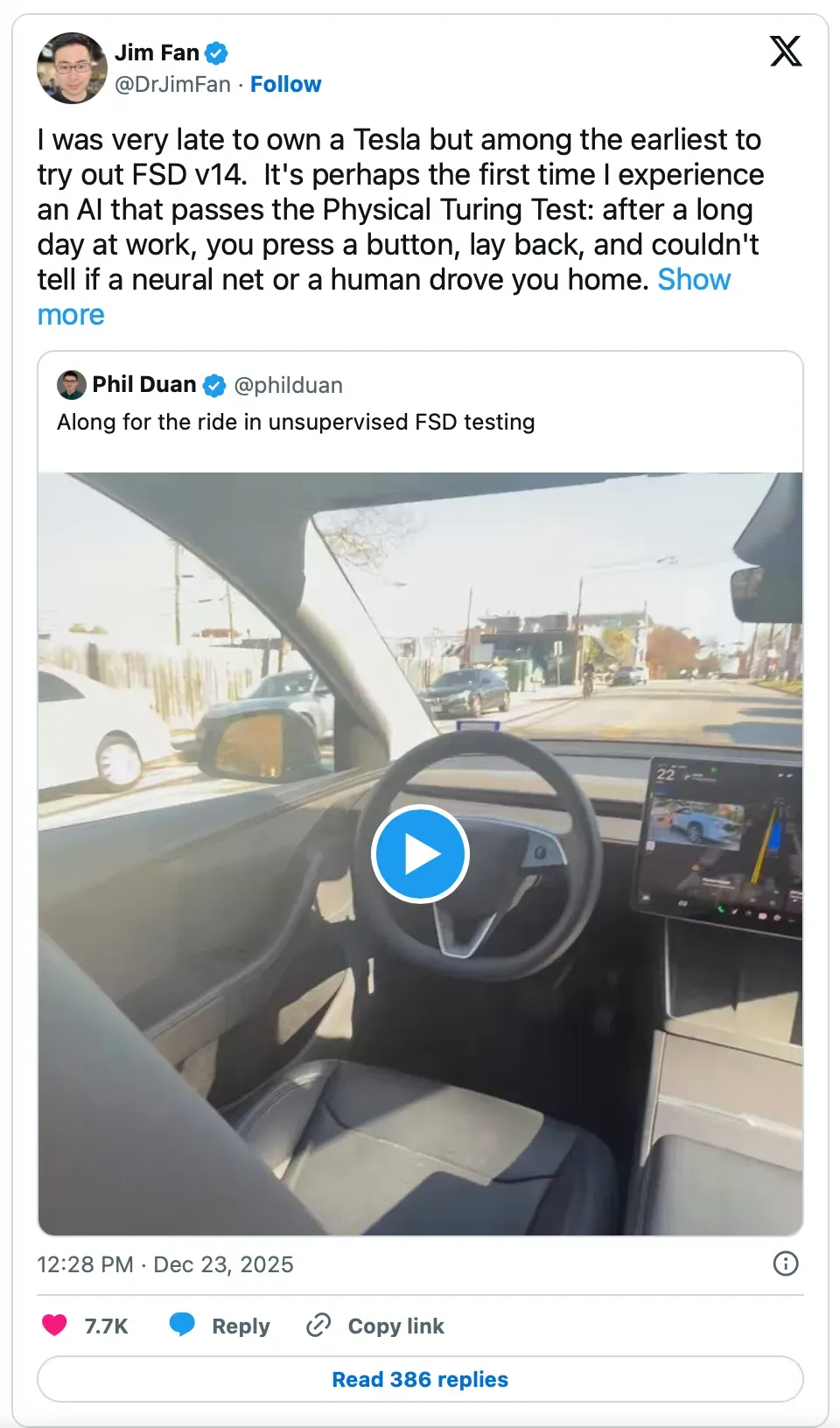
NVIDIA Robotics Director Hails Tesla FSD v14 as First AI to Pass "Physical Turing Test"
NVIDIA's Director of Robotics, Jim Fan, declared Tesla's Full Self-Driving (FSD) v14 the pioneering AI system to pass a "Physical Turing Test," where passengers cannot distinguish between neural network-driven control and human operation during real-world drives. Fan shared this assessment in a widely circulated X post on December 23, 2025, after testing the software, emphasizing its seamless integration into daily routines and predicting it will become as indispensable as smartphones.
Jim Fan's Testimonial and the "Physical Turing Test" Concept
Jim Fan, who co-leads NVIDIA's GEAR Team developing foundation models for embodied AI agents in virtual and physical environments, described his initial FSD v14 experience as transformative. "I was very late to own a Tesla but among the earliest to try out FSD v14. It’s perhaps the first time I experience an AI that passes the Physical Turing Test: after a long day at work, you press a button, lay back, and couldn’t tell if a neural net or a human drove you home," Fan posted on X.
He highlighted the mesmerizing aspect of the technology despite his deep expertise in robot learning: "Despite knowing exactly how robot learning works, I still find it magical watching the steering wheel turn by itself. First it feels surreal, next it becomes routine." Fan attached a video to his post demonstrating FSD v14 in action, capturing smooth maneuvers that left him awestruck. This "Physical Turing Test" adapts Alan Turing's famous imitation game to embodied AI, evaluating whether autonomous systems exhibit human-like proficiency in physical tasks like driving without detectable artificial flaws.
Fan foresaw profound societal shifts: "Then, like the smartphone, taking it away actively hurts. This is how humanity gets rewired and glued to god-like technologies." His endorsement carries weight given NVIDIA's dominance in AI hardware, including GPUs powering Tesla's Dojo supercomputer for FSD training.
Tesla FSD v14 Technical Advancements and Rollout
FSD Supervised v14.2.2, the latest iteration, began wide rollout this week, with owners reporting enhanced performance. Key improvements include hesitation-free lane changes, smoother decision-making, and precise handling of complex urban scenarios, building on Tesla's end-to-end neural network architecture trained on billions of miles of real-world data.
NVIDIA CEO Jensen Huang previously affirmed Tesla's lead in autonomous driving during a mid-2024 Yahoo Finance interview: "Tesla is far ahead in self-driving cars, but every single car, someday, will have to have autonomous capability." FSD v14 leverages vast video datasets from Tesla's fleet, enabling the AI to generalize human-like behaviors without hardcoded rules.
The software remains "supervised," requiring driver attention, but Fan's review suggests it's approaching unsupervised viability. Tesla reports FSD v14 achieves intervention rates under 1 per 1,000 miles in optimal conditions, a stark improvement from earlier versions.
Broader Industry Praise and Global Momentum
Fan’s praise echoes growing acclaim for Tesla's autonomy stack. South Korean National Assembly member Lee Soyoung tested FSD and urged colleagues to experience it firsthand, noting South Korea's nascent self-driving sector: "I would encourage my colleagues to try out self-driving and autonomous technologies for themselves."
Tesla plans European expansion in 2026, with Dutch regulator RDW confirming readiness for FSD deployment. This follows regulatory nods in North America and China, where FSD Beta has logged millions of miles. Market reaction was muted, with TSLA shares dipping 0.11% to $485.03 in after-hours trading on December 23, though analysts highlight strong momentum and quality metrics.
Competitive Landscape and NVIDIA-Tesla Synergies
NVIDIA's endorsement underscores synergies between the firms. Tesla relies on NVIDIA H100 GPUs for Dojo training, while NVIDIA's Project GR00T advances humanoid robotics, potentially integrating Tesla's Optimus insights. Fan's GEAR Team focuses on multimodal AI for physical agents, mirroring FSD's vision-language-action fusion.
Competitors like Waymo and Cruise lag in scalability; Waymo operates geo-fenced fleets, while Tesla's approach scales via consumer vehicles. FSD v14's "physical" realism—handling unprotected turns, pedestrians, and edge cases—sets a benchmark, with data showing 10x fewer disengagements than rivals per NHTSA reports.
Implications for AI, Robotics, and Mobility
Fan’s "Physical Turing Test" milestone signals embodied AI's maturation, blurring human-machine boundaries in transportation. This could accelerate regulatory approvals, with unsupervised FSD eyed for 2026 Cybercab robotaxis. Economically, autonomy promises $10 trillion in value by 2030 per ARK Invest, reshaping insurance, logistics, and urban planning.
Challenges persist: safety scrutiny post-2024 incidents demands transparency, and ethical questions around AI "rewiring" humanity loom. Yet, as Fan notes, routine adoption will normalize god-like capabilities, propelling the industry toward Level 5 autonomy.
This breakthrough positions Tesla at the vanguard, with NVIDIA's validation amplifying its lead amid intensifying AI arms races.


