
Recursive Language Models: Breaking the Context Ceiling
Recursive Language Models are redefining how AI systems handle infinite context windows, enabling models to reason across exponentially larger problem spaces without architectural redesign.
The Context Crisis in Modern AI
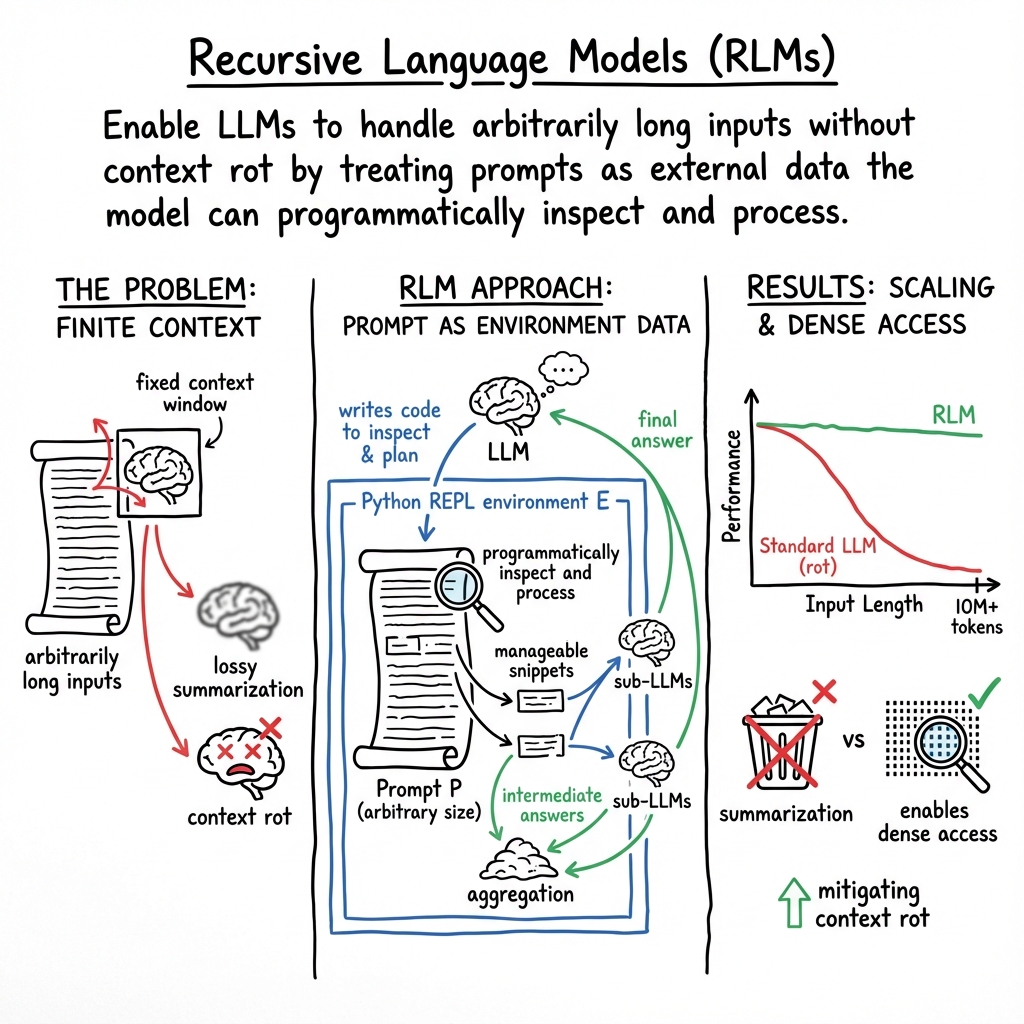
Language models have hit a fundamental wall: context windows, while growing, remain finite. A 128K token window sounds vast until you're processing a full codebase, a multi-year conversation history, or a research corpus spanning thousands of papers. The industry's response has been incremental—longer windows, better compression—but Recursive Language Models (RLMs) represent a categorical shift in how systems can handle information at scale.
Rather than expanding context through brute force, RLMs introduce a recursive architecture that allows models to call themselves on sub-problems, decomposing complex reasoning tasks into manageable chunks. This isn't just an engineering optimization; it's a fundamental rethinking of how language models process information.
How Recursive Language Models Work
At their core, RLMs enable a model to generate prompts for itself, creating a self-referential loop that can theoretically extend to infinite depth. According to research documented on Tekta.ai, the architecture allows:
- Self-prompting: Models generate intermediate prompts to break down complex tasks
- Hierarchical reasoning: Problems decompose into sub-problems solved recursively
- Scalable context: Each recursive call operates within manageable token limits while maintaining coherence across layers
- Emergent capabilities: Complex reasoning emerges from simple recursive patterns
The practical implication is striking: a model with a 4K token window could theoretically reason across problems requiring millions of tokens of context by recursively subdividing the work.
Real-World Applications and Demonstrations
The concept moves beyond theory. A GitHub implementation demonstrates an infinitely scalable recursive model architecture, while video demonstrations on YouTube show RLMs tackling long-context reasoning tasks that would overwhelm traditional models.
Potential use cases include:
- Code analysis: Processing entire repositories to understand dependencies and architecture
- Document synthesis: Summarizing and cross-referencing thousands of documents
- Multi-turn reasoning: Maintaining coherence across extended conversations with intermediate conclusions
- Scientific research: Synthesizing findings across vast literature without truncation
The Competitive Landscape
This development arrives at a critical moment. Companies like OpenAI, Anthropic, and others are racing to expand context windows—Claude now supports 200K tokens, while others pursue even longer sequences. But RLMs suggest a different path: rather than building bigger models, build smarter recursion.
The advantage is architectural elegance. RLMs don't require proportionally larger models or exponentially more compute for longer reasoning chains. They work within existing constraints while enabling emergent capabilities.
Technical Challenges Ahead
RLMs aren't without friction. Key challenges include:
- Coherence degradation: Maintaining semantic consistency across recursive layers
- Computational overhead: Recursive calls introduce latency compared to single-pass inference
- Training complexity: Teaching models to effectively self-prompt requires novel training approaches
- Error propagation: Mistakes in early recursive calls can cascade through subsequent layers
The Broader Implications
If RLMs mature, they could reshape AI architecture fundamentally. Rather than pursuing ever-larger models, the field might pivot toward recursive, self-referential systems that achieve superhuman reasoning through decomposition rather than scale.
This isn't about replacing context windows—it's about transcending them. The question isn't whether models can handle 200K or 1M tokens; it's whether they can handle infinite reasoning depth through recursive self-improvement.
The research is early, but the direction is clear: the next frontier in language models may not be bigger, but smarter.


